Training teaches medicine. Almost nothing in training teaches the career system that surrounds it — the meetings where fellowships quietly take shape, the societies where committee seats turn into recognition, the certification machinery that hums along whether or not you are watching it, and the mentors who change trajectories with one well-timed introduction. Two clinicians with identical clinical skills can land in very different places a decade out, and the difference is rarely the medicine. It is how deliberately each one worked the professional layer.
That layer feels more confusing than it used to. Meetings went hybrid, hallway serendipity thinned out, and plenty of clinicians now ask whether conference networking is still worth the badge and the coffee queue. The honest answer: the structures underneath — visibility, relationships, credentials, sponsorship — did not change, and they still run substantially through the conference and society circuit. This guide maps that layer end to end; the linked guides carry the detailed playbooks.
The career layer has four moving parts
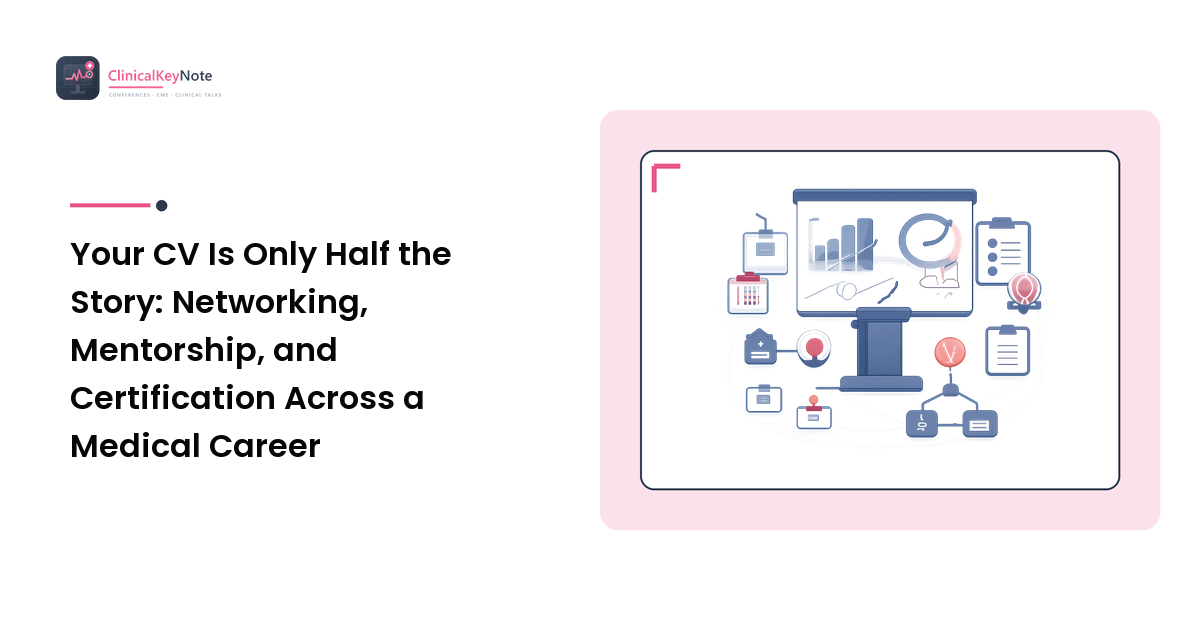
Strip away the anecdotes and career development on the professional circuit comes down to a network that knows your work, credentials kept current without drama, mentors and sponsors who act on your behalf, and priorities that match your career stage. None of them requires charisma or luck. All of them reward starting earlier than feels necessary — which is exactly why the meetings you choose matter; if you have not built that decision process yet, start with our guide to choosing a conference worth attending and come back.
Networking that does not feel like networking
The word conjures a rented ballroom and a stack of business cards, which is why so many clinicians opt out. Reframe it: networking is becoming known for something specific by the small community of people who already care about that thing. On the conference circuit, that happens in predictable places, and almost none of them are the exhibit-hall mixer.
The work is the introduction. The most natural networking at any meeting happens around presented work. A poster gives every passer-by a reason to talk to you, and a thoughtful question in the aisle gives you a reason to talk to any presenter — including the senior author standing beside the trainee. If you have work worth submitting, submit it; an accepted abstract converts an anonymous attendance into a scheduled reason for people to find you. The mechanics, from the call for abstracts to the poster hall, live in our abstracts and posters guide, and delivering the work well is a learnable craft covered in our presenting-skills guide.
Smaller rooms beat bigger badges. A subspecialty society's mid-sized meeting, a regional chapter session, or a workshop with thirty chairs will generate more durable professional relationships than a flagship congress with tens of thousands of delegates. The people you meet are more likely to be your actual community — the ones reviewing your abstracts and, later, your job applications.
The meeting is the introduction; the follow-up is the relationship. A short message within the week — referencing the actual conversation, offering something concrete (the reference you mentioned, a shared interest, a specific question) — is what separates a contact from an acquaintance. Most people never send it, which is precisely why it works.
Committees compound. Volunteering for a society working group, an abstract-review pool, or a chapter role puts you in repeated, low-pressure contact with the senior people in your field, doing visible work together. One committee seat held for a few years typically does more for a career than a decade of passive attendance.
Certification: keep the credential layer boring
Nothing derails a career phase like credential trouble, and nothing is easier to keep uneventful with a little system. Two clocks run in parallel for most clinicians: licensure renewal, fed by CME/CE, and board certification, maintained through continuing-certification programs.
The details genuinely vary — by board, by state or country, by profession — so treat every specific figure you hear as a prompt to check, not a fact to rely on. What is typical: licensing bodies require a quantity of accredited CME or CE per renewal cycle, sometimes with mandated topics, and specialty boards run their own continuing-certification requirements on their own timetables. Verify your actual numbers with your own licensing board and certifying board, put the renewal dates in your calendar with a long lead, and claim credit as you earn it rather than reconstructing a cycle at the deadline. How the credit machinery works — accreditation, categories, claiming windows, tracking — is covered in our guide to how CME credit actually works, and the continuing-certification side has its own walkthrough in Maintenance of Certification, explained.
The career-development move is to make the two clocks pay career dividends: choose meetings that serve your credit needs and your visibility goals at once. A meeting in your subspecialty where you present a poster, earn accredited credit, and sit in on the society's business meeting is triple duty; a random credit-harvesting webinar is single duty at best.
Mentors and sponsors are different jobs
The words get used interchangeably; the roles are not. A mentor advises you — career questions, manuscript drafts, honest reads on your options. A sponsor spends their own credibility on you — putting your name forward for the panel, the committee, the job, often in rooms you are not in. Careers need both, and they are frequently different people.
The conference circuit is the natural habitat for finding each. The moderator who asked a sharp question at your poster, the discussant who engaged with your talk, the committee chair you have now served under for two cycles — these relationships start small and professional, which is exactly how the durable ones begin. Many specialty societies also run formal mentorship programs that match trainees or early-career members with senior colleagues; check whether yours does, because opting in is the lowest-friction mentorship there is.
Two habits make you worth investing in. Be specific: "Can I ask you three questions about choosing between these two paths?" is answerable; "Will you be my mentor?" is homework. And close the loop: report back on what you did with the advice. Nothing recruits a sponsor faster than evidence that investment in you converts into delivered work.
What to prioritise at each career stage
The circuit rewards different moves at different points, and one common mistake is running a senior clinician's conference strategy on a trainee's timeline — or the reverse.
Students and residents: optimise for reps and visibility, not prestige. Present anything presentable — case reports, quality projects, early research — at meetings where trainees genuinely present, which often means regional and society meetings rather than flagship congresses. Start the relationships that become fellowship and job references. Money is a solvable problem at this stage: institutional travel funds, society trainee grants, and presenter support exist, and our guide to getting a conference funded by your employer covers how to ask.
Fellows and early career: pick your community deliberately. Choose the one or two societies that map to the career you want and go deep — attend consistently, volunteer for review pools and working groups, and move from consuming sessions to contributing to them. This is also when certification and licensure clocks start running in earnest; set the tracking system up now, while it is trivial.
Mid-career: convert accumulated credibility into platform. Chair sessions, join program committees, mentor formally, and start sponsoring — putting junior colleagues' names forward is both the job and, not incidentally, what builds a reputation as someone worth knowing. Guard against meeting inertia: recheck every standing conference commitment against what your career needs now.
Senior: leverage and legacy. Society leadership, keynote and visiting roles, mentorship at scale — and the same boring discipline on certification and credit as everyone else, because the credential layer never becomes optional.
FAQ
Is conference networking still worth it if I mostly attend virtually?
Virtual attendance is efficient for content and credit but thin for relationships — chat boxes rarely produce sponsors. A workable pattern is to take routine content virtually and spend the in-person budget on the one or two meetings where your actual community gathers, then work those meetings deliberately: present, follow up, volunteer.
How do I network at a large meeting as an introvert?
Use structure instead of small talk. Poster aisles, workshops, and committee meetings all give you a defined role and a built-in topic; a prepared question after a session is a professional opening, not an imposition. Two or three real conversations per meeting, each followed up in writing, beat fifty exchanged introductions.
What is the difference between a mentor and a sponsor?
A mentor gives you advice; a sponsor gives you opportunities — advocating for you in decisions and rooms you never see. Mentors can be asked for directly; sponsors are earned by delivering visible work where senior colleagues can see it, which is much of what committees and presenting are for.
How many professional societies should I join?
Fewer, more deeply. One or two societies where you attend consistently and hold some active role will outperform half a dozen passive memberships. Choose the ones whose meetings your intended community actually attends, and revisit the choice when your career stage changes.
Does committee and society work actually advance a career?
Generally, yes — it creates repeated visible collaboration with the senior people in your field, which is how sponsorship starts. The caveat is scope: one substantial role done well builds a reputation, while several neglected ones quietly damage it.
The circuit is a career tool — treat it like one
Your clinical work earns the credential; the professional layer decides who knows about it. Pick meetings on purpose, present when you can, keep the certification clocks boring, and invest in the handful of relationships that compound. For the reference guides behind every piece of this — credit logistics, abstract cycles, conference selection, and the specialty meeting landscape — browse the clinician resources on ClinicalKey Note.