Most large specialty meetings now run in some hybrid form: a live meeting with a streamed track, and an on-demand library that opens afterwards. That turned a simple question — do I go? — into a three-way one: in person, live-streamed, or on demand later. Because registration tiers, credit designations, and claiming windows often differ by tier, the choice has consequences beyond convenience.
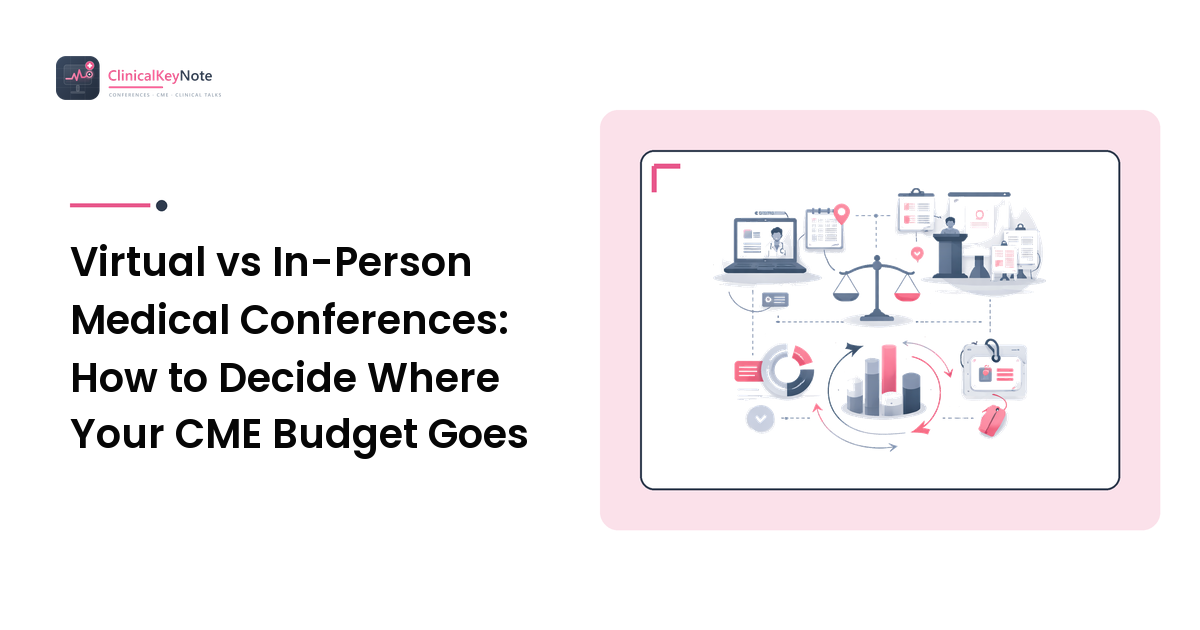
The takeaway up front: format is not a quality question, it is a matching question. Virtual attendance is generally the more efficient way to accumulate content and credit hours. In-person attendance is the only way to do what requires being in the room — presenting, hallway conversations, mentor asks, committee and society involvement. Deciding well means naming which of those jobs you need this meeting to do, then buying the format that does it. Most clinicians should end up with a mixed calendar rather than a policy.
Credit rules, categories, and cycle requirements vary by board, accreditor, and organizer — treat everything here as the typical pattern and verify specifics with your own licensing board, your certifying board, and the meeting organizer.
Start by naming the job
A meeting can do four distinct things for you. Rank them before you look at a registration page, because each is served by a different format.
- Credit. Designated hours toward a licensure or certification requirement.
- Content. A specific update — a guideline session, a subspecialty track, a methods workshop.
- Network. Meeting people: collaborators, a program director, a future employer, a mentor.
- Visibility. Presenting, moderating, chairing, standing for a society role, or otherwise being seen.
Jobs 1 and 2 are largely format-agnostic and often cheaper virtually. Jobs 3 and 4 are almost entirely in-person goods. A clinician whose honest answer is "credit and content" is frequently paying for travel to get what the streamed tier delivers; a resident whose answer is "visibility, and I have a poster" gets very little from a screen. The general planning frame is in our guide to choosing a medical conference worth attending; this is the modality layer on top of it.
How credit actually differs by format
This is where the formats genuinely diverge, and where people lose hours they thought they had.
Live vs enduring. Accreditation systems generally distinguish a live activity — happening in real time, in a hall or streamed — from an enduring material, recorded content available over a defined period. Both can be designated for credit by an accredited provider, but they are different activity types with different documentation.
Where the distinction bites. Certifying boards' continuing-certification programs, credentialing committees, and some state and specialty requirements may treat live participation, enduring materials, and self-assessment activities differently, or cap how much of a cycle can come from one type. Nursing CE is structured differently again, typically counted in contact hours through a separate accreditation pathway. None of this is universal — check current rules with your own board and accreditor before assuming an on-demand library satisfies a requirement.
Claiming windows. Virtual and on-demand tiers often carry their own claiming deadlines, separate from the live meeting's, and on-demand credit is usually claimable only while the library is open. This is the most common way virtual credit quietly evaporates: the content is still watchable months later, but the claiming portal closed. If credit did not post as expected, the diagnostic steps are in our guide to why your CME credit didn't count.
Attendance verification and tiers. Streamed and on-demand activities verify participation differently — session attestation, embedded questions, watch-time thresholds — so read how the organizer measures it before you multitask through a session. And a cheaper virtual tier may exclude workshops or ticketed sessions that carry credit: compare the designated hours available to your tier, not the headline total. For the underlying machinery, see how CME credit actually works.
The cost model, honestly built
Comparing registration fees is not a comparison. Build the full line-item list for each option.
In person: registration (early-bird vs standard vs on-site — the spread is usually material), travel and transfers, lodging for the nights the program actually requires, meals not covered, ticketed sessions and society dinners, clinical coverage, and travel days either end.
Virtual: registration, which is often lower and occasionally tiered by how long the library stays open — plus time, which is the hidden cost. Virtual attendance rarely gets protected. Clinicians routinely register, get pulled into clinical work, and watch a fraction of what they paid for.
The comparison that matters is cost per outcome you actually needed, not cost per credit hour. If the goal was credit, cost per claimed hour is a fair metric and virtual usually wins decisively. If the goal was a specific collaboration or a program-director conversation, that denominator is simply wrong and will talk you into the wrong choice. The conversation you cannot schedule has real expected value and no invoice, which is why it loses every spreadsheet argument.
Where each format quietly wins
Virtual wins on:
- Parallel tracks. In person, competing sessions force a choice; on demand you can take both. For meetings with four or five simultaneous tracks this is a real advantage, not a consolation.
- Spreading credit across the cycle, claiming hours across months rather than in one exhausting block — useful if your requirement has a category mix to satisfy.
- Re-watching. Methods sessions, statistics workshops, and guideline updates reward a second pass. A live room does not offer one.
- Accessibility and caregiving. Clinicians with caregiving responsibilities, travel barriers, visa constraints, or no travel budget get access they otherwise would not have — the most important thing hybrid formats changed.
- Sampling an unfamiliar society at virtual cost before committing travel funds next cycle.
In person wins on:
- Presenting. A poster in a physical hall gets stopped at by people walking past; a virtual poster gets clicked by people who already searched for it. For a trainee building a record, that difference is the entire point — see our guide to submitting a conference abstract.
- The unplanned conversation. Nearly every useful conference outcome that was not on the program came from a corridor, a queue, or a session that ran late.
- Asking a specific person a specific question. Approaching a speaker after their talk works; emailing afterwards works far less often.
- Society and committee involvement. Business meetings, interest groups, and committee recruitment happen in rooms.
- Focus. A clinician away from the hospital attends. A clinician at their desk with a stream open gets paged.
A decision rubric you can run in ten minutes
For each candidate meeting:
- Write the job. One sentence: what has to be true for this to have been worth it? "I need eight designated hours" and "I need to meet two people in the vascular group" lead to different tiers.
- Check the credit fit. Which activity types do your board and certifying program accept, and in what mix? Verify directly — do not carry over last cycle's assumption.
- Read the tier tables. Sessions included, designated hours available to that tier, on-demand access duration, and the claiming window for each.
- Price both fully, including clinical coverage and travel days.
- Ask whether you are presenting. If yes, attend in person; this is close to a rule.
- Check protection. If you choose virtual, can you actually block the time? If not, the registration is a donation. Book the hours as leave in the same act as registering.
Build a portfolio, not a policy
The clinicians who get the most out of a cycle rarely commit to one format. A workable default shape:
- One anchor in-person meeting per cycle — the society meeting where your people are, where you present, and where the relationships live. Fund it properly and go for the whole thing.
- Virtual attendance at two or three others for content and credit, chosen for specific tracks rather than reputation.
- On-demand libraries to fill remaining hours and cover sessions you missed at the anchor meeting, claimed early rather than in the last week.
Front-load the claiming: claim after each activity while the portal is open and file the certificate immediately. A cycle's worth of certificates assembled in the fortnight before renewal is how documentation gaps happen.
This portfolio also argues well to an employer. One in-person meeting plus a virtual registration is easier to approve than two travel requests, and it lets you show the coverage plan alongside the cost — the framing in our guide to getting conference attendance funded.
FAQ
Does virtual CME count the same as in-person CME?
Often, but not always. An accredited provider can designate both live-streamed sessions and recorded enduring materials for credit, but boards and continuing-certification programs may treat activity types differently or limit how much of a cycle can come from one. Verify with your licensing board, your specialty board, and the organizer's credit statement before relying on it.
Is on-demand conference content available indefinitely?
No. Organizers open on-demand libraries for a defined period, and the claiming window is usually shorter than the viewing window. Note both dates when you register and claim as you go.
Should a resident attend virtually to save money?
If the resident is presenting, on the job market, or building relationships in a subspecialty, in person is worth arguing for — those are the goods a stream does not carry, and most programs have some funding mechanism. Virtual is reasonable for pure content and credit, or to sample meetings before committing travel funds.
How do I document virtual attendance if I'm audited?
The same way as any activity: keep the certificate issued after you complete the organizer's evaluation and attestation. Save it at the moment you claim rather than intending to retrieve it later, and keep everything in one place for at least the retention period your board states.
Choose the format that does the job
Format is a tool, not a loyalty. Name what the meeting has to accomplish, check what your board accepts, price both options fully, and build a year that mixes one properly funded in-person anchor with targeted virtual and on-demand hours. For the reference guides on picking meetings and getting value from them, see the Choosing & Attending resources on ClinicalKey Note.